

MEET TODAY’S AUTHOR
Rebecca Sandulak
Rebecca was the first female IATSE set photographer in Manitoba. She once appeared as a guest on The Martha Stewart Show for original eco-fashion created for animals. Based in Toronto, Sandulak is now a writer and independent producer. She is a proud parent of two kids, one old dog, and a cat. A lifelong fan of rap music and bona fide rink rat.
Rebecca reached out to me to share the story of her dear friend Nicole Beare. I am so honored to share women’s hockey history.
View the photo gallery on Instagram:
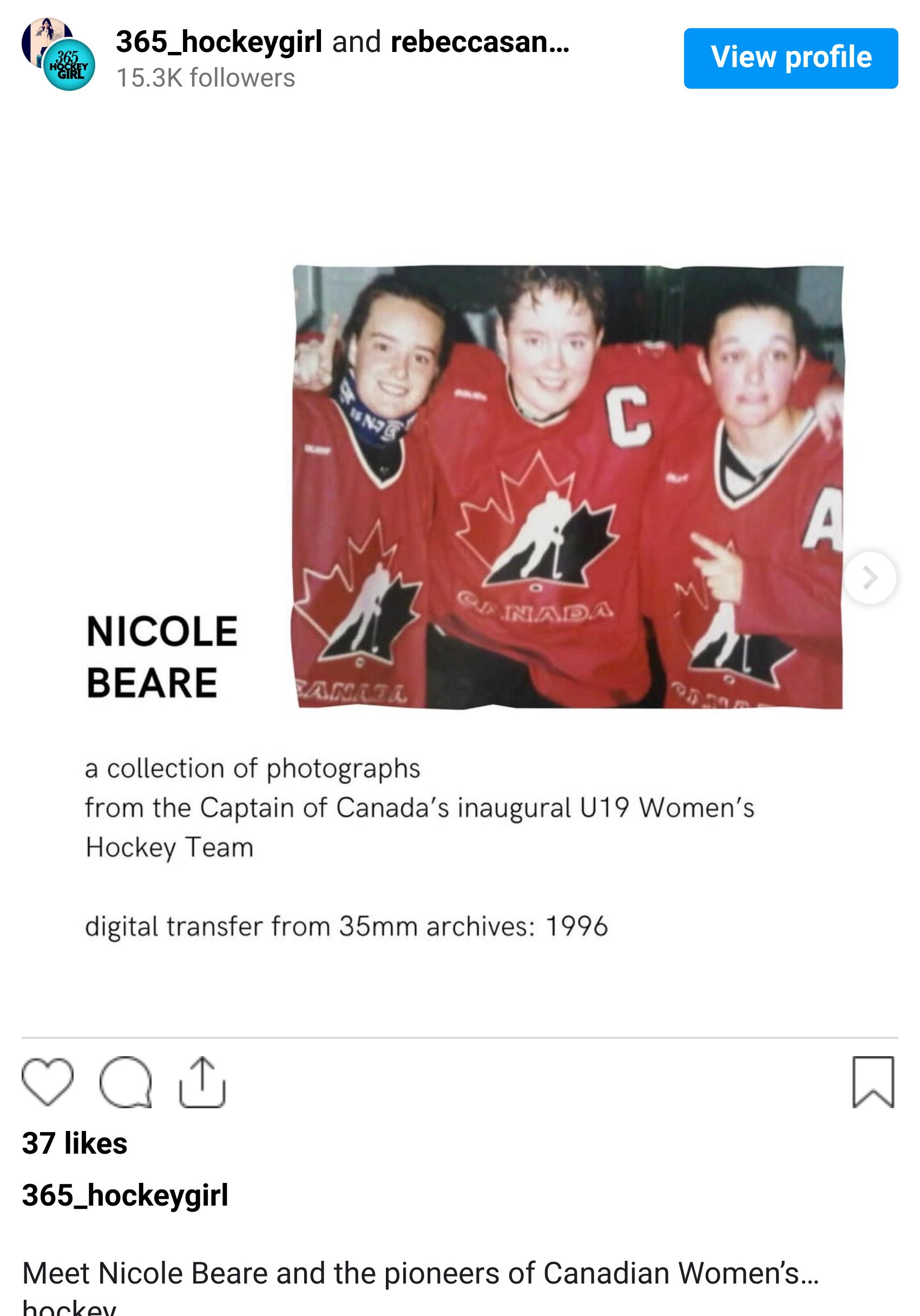
The Captain: Nicole Beare’s Quiet Legacy at the Birth of Canada’s Junior Women’s Hockey
When Hockey Canada quietly launched its first national under-19 women’s program in 1996, few could have predicted how profoundly that moment would shape the future of the sport. Even fewer would recognize, nearly three decades later, the role played by a right-shooting forward from small-town Manitoba who became the program’s first captain.
Nicole Beare, born June 22, 1979, in Brandon, Man., emerged as one of the earliest leaders of Canada’s junior women’s national system at a time when women’s hockey operated with limited visibility, sparse infrastructure, and minimal historical record-keeping.
Selected from Manitoba to the inaugural under-19 national roster, Beare was entrusted with the captaincy of a team that, quite literally, had no blueprint. The program represented the first formal national development pathway for elite female players under 19, filling a structural gap that had long existed in Canadian hockey. Those athletes were pioneers. They were asked to lead without precedent.

U19 Team Canada teammates and roomates: Caroline Ouellette and Nicole Beare
A Leader in a Foundational Era
As captain, Beare represented more than on-ice leadership. She embodied the breakthroughs taking place across women’s sport in the mid-1990s by moving from grassroots participation toward national recognition. Openly queer at a time when few athletes were, Beare led authentically, both on and off the ice, during an era when visibility carried risk as well as responsibility.
The inaugural team was coached by Danièle Sauvageau - now a Hockey Hall of Fame builder and one of the most influential figures in women’s hockey history along with assistant coaches Julie Healy and Karen Hughes. Beare also trained within the broader senior national environment under Shannon Miller, prior to women’s hockey making its Olympic debut at the 1998 Nagano Games. Beare was listed as an alternate for the team.
Her teammates and training partners included players who would go on to define the sport globally: Manon Rhéaume, Angela James, Danielle Goyette, France St-Louis, Jayna Hefford, and future Hall of Famer Caroline Ouellette, with whom Beare roomed as a teenager despite a language barrier that never hindered mutual respect.

U19 Team Canada coaching staff: Julie Healy, Daniéle Sauvageau, Karen Hughes with Nicole Beare
From Carman Cougars to the National Stage
Beare’s path to the Maple Leaf began far from national training centres. Raised in Wawanesa and developed through the Carman Cougars minor and high-school hockey system, she started skating by age three and joined the Cougars in 1992. Playing in co-ed and boys’ leagues during the early 1990s when such opportunities for girls were rare, she quickly earned a reputation for speed, competitiveness, and high hockey IQ.
The Cougars’ 1996–97 season, in which the team finished as provincial finalists with a 28-15-2 overall record, anchored Beare’s development in a high-performance local environment. Publicly posted rosters from that year list her among the team’s core players, underscoring that her rise was rooted not only in individual talent but in a strong community program.
That foundation carried her to provincial representation with Team Manitoba, including Canada Winter Games involvement, and eventually to the national stage. In 1997, she was nominated for Manitoba Athlete of the Year.

U19 Team Canada Women’s Hockey: Various unidentified players with Nicole Beare, Cindy Klassen, Isabelle Chartrand, Kelly Bechard, and Caroline Ouellette
National Champion at the Club Level
After her junior national experience, Beare continued at the elite senior club level, joining the Calgary Oval X-Treme - one of Western Canada’s dominant women’s teams of the era. In 1998, the Oval X-Treme captured the Abby Hoffman Cup, Canada’s national women’s club championship (the Esso Nationals).
Tournament reporting from that championship credits Beare with offensive production during the title run. Hockey Canada records from the event list her with eight points in seven games, placing her among the team’s top contributors in a roster that included future Olympic and world champions.
An Under-Recognized Pioneer
Like many women’s hockey stories from the 1990s, Beare’s career unfolded during a period when coverage was limited and statistics were often confined to local newspapers and printed programs. Full game-by-game records from her provincial and club seasons remain difficult to access today.
Yet her presence on elite rosters including provincial, national, and championship-winning club teams confirms her calibre at a time when simply reaching those levels required navigating systemic barriers that no longer exist to the same degree.
Beyond hockey, Beare was also a standout multi-sport athlete, earning selection to the Manitoba All-Star Soccer Team and competing nationally at the Rocky Mountain Cup, while also excelling in baseball, volleyball, cross-country running, badminton, and basketball. She was also nominated for Manitoba Athlete of the Year in 1997.

Captain Nicole Beare with unidentified U19 Team Canada players
A Family and Community Legacy
Sport ran deep in the Beare household. Nicole’s father, Ed Beare, and brother, Troy Beare, along with cousin Scott Beare, are all inductees of the Manitoba Baseball Hall of Fame and recognized for their roles with teams such as the Riverside Canucks and Carman Junior Goldeyes. That multi-generational legacy of competition and community sport helped shape Nicole’s understanding of leadership and team identity.
For Carman, her story links today’s youth skating with the Cougars to a time when girls had to fight - sometimes literally - for space on the ice. For Manitoba, it preserves a chapter of women’s hockey history at risk of being overlooked. And for the sport nationally, it highlights the human foundations beneath Canada’s later dominance on the world stage.
As women’s hockey experiences unprecedented growth, from professional leagues to packed arenas, the sport’s early builders are increasingly being re-examined. The 1996 Canadian under-19 women’s national team was not merely a roster; it was the starting point of a system.
Nicole Beare’s captaincy sits squarely within that origin story.
Honouring figures like Beare does more than fill historical gaps. It restores context, acknowledges resilience, and reminds future generations that the path forward was built quietly - often in small towns, with little recognition, by athletes who led simply because someone had to go first.